
The little animal was strolling down the road when a Thai man who had just finished his shift noticed it.
Upon closer inspection, I discovered that it was a kitten that hadn’t had a meal in two days. The kitten was deaf from birth.
The man chose to take the cat and wait at home after realizing that he was alone and unable to assist him. The animal has no chance of surviving if it is abandoned on the street.
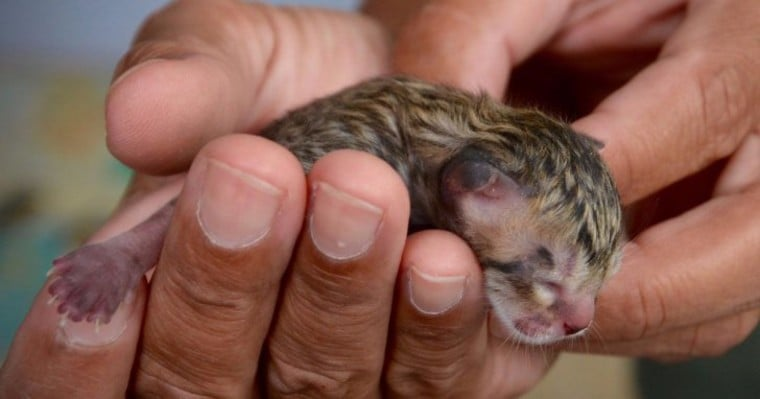
The man took care of the kitten and gave it a bottle of milk after bringing it home. The animal settled into the man’s home and felt at ease with its new owner.
The kitten started to develop and mature over time. The man concluded that the creature he was tending to did not resemble a cat in the slightest.

He was clearly a member of a different species as he grew older. When the man went to a veterinarian for assistance, the veterinarian informed him that the animal in question was actually a fishing cat.
The fishing cat has thick, silky, glossy fur all over its body. The fur is brown on the back and grey-gray on the face and sides.

Little black or dark brown patches of varying sizes are uniformly spaced throughout the fur in vertical stripes, particularly on the sides and back. Adults weigh 8–14 kg, measure 75–86 cm in length, and have a 25–33 cm tail.
The legs are only partially folded, the claws are sharp, and the toes are slightly webbed. Long and slightly webbed at the ends are the legs.
A person who is proficient in capturing fish, snakes, frogs, crabs, crustaceans, crayfish, snails, and other aquatic creatures and insects in a semi-aquatic setting is said to be “catfishing.”