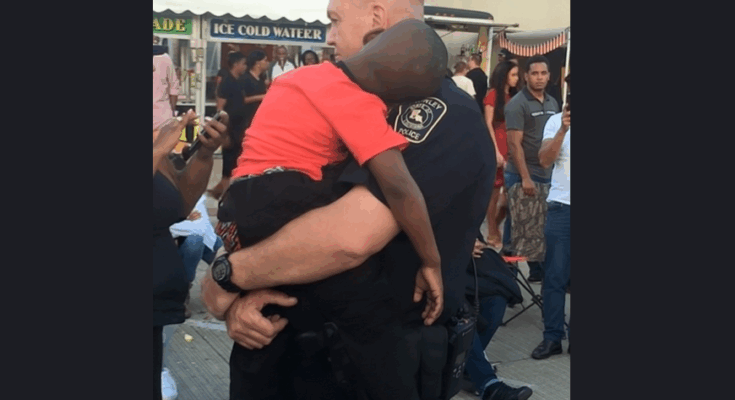
The entire neighborhood was crammed into the streets for the Juneteenth festival, which featured food trucks, music, and boisterous children. My nephew Zavi was gone when I turned around after a brief moment of distraction to pay for a funnel cake.
I felt a surge of panic. Dropping everything, I began calling his name and looking at every face in the crowd as well as every bounce house. He was snuggled up, sound asleep, in a police officer’s arms, and I was only two seconds away from dialing 911.
The cop stood off to the side, seemingly unfazed by the situation, as if it had happened before. He nodded slightly as I hurried up, panting and trembling. Zavi reportedly became exhausted after wandering off close to the snow cone truck. As if it were insignificant, he stated, “Didn’t want to leave him alone.”
I tried to ignore it, thanked him, and took Zavi back. However, I heard individuals behind me talking on their phones in whispers. While some were grinning, others weren’t. “Must be nice to get that kind of response,” mumbled a woman by the food stall, shaking her head.
I didn’t understand it at first. Then it made sense.
They weren’t discussing Zavi dozing off. They discussed who was holding him and what may have happened if there had been even a small change.I can’t stop wondering now. If he didn’t appear so tiny, so innocuous, and so worn out, would he still be safe?
Heavy and unnerving, the question hovered in the air. It crept into my head and played the scene over and over again. His name was Officer Davies, and he had been a truly good man, a comforting presence during my period of absolute dread. After giving Zavi a quick explanation and a kind smile, he handed him over. Is that the end of the story?
The comments, glances, and whispers, however, created a different picture, one that was filled with the intricacies of perception and race. Could Zavi have been taller and older? What if he had been wandering instead of sleeping, perhaps a little terrified or confused? Would the exchange have been identical? Would Officer Davies have been as composed when he approached him? Or would his acts have been tainted by suspicion?
Sleep was elusive that night. Officer Davies was holding Zavi every time I closed my eyes, but the vision kept changing. Zavi would occasionally reach out to touch the officer’s badge while giggling. At other moments, he was fidgeting, making ambiguous movements with his tiny hands. Additionally, the officer’s grip tightened and his features hardened in those darker visions.
I couldn’t get rid of the feeling the following day. I discussed it with Zavi’s mother, my sister. She had also heard the murmurs. Both of us had witnessed the looks. And we both secretly understood that Zavi’s skin tone affected how people interpreted that particular moment.
We made the decision to take action. Not to be angry or to start a fight, but to start a conversation and perhaps even bring about a small change. In our social media posts, we meticulously described the events, commended Officer Davies for his generosity, and acknowledged the underlying racial animosity that had permeated the gathering.
The post became widely shared. Support, rage, and denial were among the many comments that flooded in. We were accused by others of being too sensitive and of making a big deal out of nothing. Others related comparable tales of how their encounters with law enforcement were influenced by their race.
One comment caught my attention. It came directly from Officer Davies. Although he acknowledged that he recognized the underlying concerns, he thanked us for acknowledging his conduct. He claimed that it served as a reminder of the tasks and discussions that still needed to be completed.
That resulted in a surprising turn. We were contacted by the local police department. They intended to highlight implicit bias and community relations while using our experience as a training opportunity. They asked us to discuss our experiences and viewpoints at a town hall meeting.
It made me anxious. Speaking about something so delicate and unfiltered in front of a crowded room full of people, including a few police officers. However, we succeeded. We discussed our anxiety when Zavi vanished, our relief upon his safe return, and the unnerving insight that the story could have turned out very differently.
That evening, Officer Davies was present. He also spoke, offering his personal opinions and insights. He discussed his desire to be a constructive member of the community and his awareness of the historical background that influenced people’s opinions.
It was not an easy chat. Tensions, arguments, and difficult realities were all present. However, there was also a feeling of sincere listening and an eagerness to participate. It seemed like a tiny move, but it was a step in the right direction to close the divide between the police and the community.
The satisfying outcome wasn’t about solving a straightforward problem or fixing years’ worth of structural problems. The goal was to establish a connection, humanize one another, and initiate a necessary dialogue. It was about transforming a period of anxiety and doubt into a chance for development and comprehension.
Officer Davies turned out to be a surprising ally. He persisted in taking part in community forums, where he promoted additional instruction on de-escalation techniques and implicit prejudice. He even launched a youth outreach program, planning activities that fostered positive interactions between children and law enforcement.
I remained active, as did my sister. Although we didn’t become activists right away, we did discover our voices. In an effort to spark similar discussions, we told our story to other community organizations.
What about Zavi? He is still a cheerful, active child who is unaware of the many facets of the day he dozed off in a police officer’s arms. But we’ll tell him about it when he gets older. We will share with him Officer Davies’ generosity, as well as the rumors and subsequent discussions. We’ll teach him to always speak up for what’s right and to be conscious of the beauty and biases of the world around him.
The lesson here is that there is always room for growth and connection, especially in times of fear and uncertainty. It’s important to confront the hard realities honestly and receptively rather than to ignore them. And sometimes a song is the first step toward the most significant transformation.
I can’t stop wondering now. If he didn’t appear so tiny, so innocuous, and so worn out, would he still be safe?
Heavy and unnerving, the question hovered in the air. It crept into my head and played the scene over and over again. His name was Officer Davies, and he had been a truly good man, a comforting presence during my period of absolute dread. After giving Zavi a quick explanation and a kind smile, he handed him over. Is that the end of the story?
The comments, glances, and whispers, however, created a different picture, one that was filled with the intricacies of perception and race. Could Zavi have been taller and older? What if he had been wandering instead of sleeping, perhaps a little terrified or confused? Would the exchange have been identical? Would Officer Davies have been as composed when he approached him? Or would his acts have been tainted by suspicion?
Sleep was elusive that night. Officer Davies was holding Zavi every time I closed my eyes, but the vision kept changing. Zavi would occasionally reach out to touch the officer’s badge while giggling. At other moments, he was fidgeting, making ambiguous movements with his tiny hands. Additionally, the officer’s grip tightened and his features hardened in those darker visions.
I couldn’t get rid of the feeling the following day. I discussed it with Zavi’s mother, my sister. She had also heard the murmurs. Both of us had witnessed the looks. And we both secretly understood that Zavi’s skin tone affected how people interpreted that particular moment.
We made the decision to take action. Not to be angry or to start a fight, but to start a conversation and perhaps even bring about a small change. In our social media posts, we meticulously described the events, commended Officer Davies for his generosity, and acknowledged the underlying racial animosity that had permeated the gathering.
The post became widely shared. Support, rage, and denial were among the many comments that flooded in. We were accused by others of being too sensitive and of making a big deal out of nothing. Others related comparable tales of how their encounters with law enforcement were influenced by their race.
One comment caught my attention. It came directly from Officer Davies. Although he acknowledged that he recognized the underlying concerns, he thanked us for acknowledging his conduct. He claimed that it served as a reminder of the tasks and discussions that still needed to be completed.
That resulted in a surprising turn. We were contacted by the local police department. They intended to highlight implicit bias and community relations while using our experience as a training opportunity. They asked us to discuss our experiences and viewpoints at a town hall meeting.
It made me anxious. Standing in front of a room full of people, including several police officers, and talking about something so raw and sensitive. However, we succeeded. We talked about our fear when Zavi went missing, our relief when he was found safe, and the unsettling realization that the narrative could have been so different.
That evening, Officer Davies was present. He spoke too, sharing his own thoughts and experiences. He talked about wanting to be a positive presence in the community, about understanding the historical context that shaped people’s perceptions.
The conversation wasn’t easy. There were tense moments, disagreements, and uncomfortable truths. But there was also a sense of genuine listening, a willingness to engage. It felt like a small step, but a step nonetheless, towards bridging the gap between the community and the police force.
The rewarding conclusion wasn’t about finding a simple solution or erasing years of systemic issues. It was about finding a way to connect, to humanize each other, to start a conversation that needed to happen. It was about turning a moment of fear and uncertainty into an opportunity for growth and understanding.
Officer Davies became an unexpected ally. He continued to participate in community forums, advocating for more training on implicit bias and de-escalation tactics. He even started a youth outreach program, organizing events that brought kids and cops together in positive settings.
My sister and I stayed involved too. We didn’t become activists overnight, but we found our voices. We shared our story with other community groups, hoping to inspire similar conversations.
And Zavi? He’s still a happy, energetic kid, oblivious to the complex layers of the day he fell asleep in a police officer’s arms. But as he grows older, we’ll tell him about it. We’ll tell him about Officer Davies’ kindness, and we’ll tell him about the whispers, about the conversations that followed. We’ll teach him to be aware of the world around him, both its beauty and its biases, and to always stand up for what’s right.
The life lesson here is that even in moments of fear and uncertainty, there’s an opportunity for connection and change. It’s not about ignoring the difficult truths, but about facing them head-on, with honesty and a willingness to listen. And sometimes, the most powerful change starts with a sing