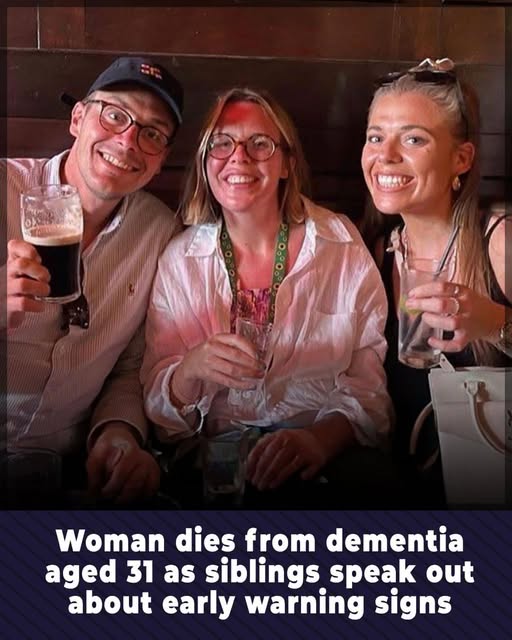
Gemma Illingworth was diagnosed at the age of 28 with a little-known form of dementia that had been silently affecting her since she was a young girl. Gemma’s family was saddened by the rare cancer that took her life just three years later; they had no idea “it was going to be that quick.”
Gemma Illingworth was lovingly referred to by her family as “a little ditsy,” eccentric, and creatively active when she was growing up in Manchester.
Despite her difficulties with visual processing, coordination, and telling time, no one suspected a major problem.
“I don’t really know, maybe we were a little in denial, but we never imagined that she was very sick. “She just needed a little extra help,” Gemma’s 29-year-old sister Jess told the Mirror. “There weren’t enough obvious symptoms to believe she had such a terrible illness.”
Her life took a tragic turn when the warning signals appeared a little less than thirty years later.
Actual symptoms show up.
Gemma’s affliction began to manifest itself in a way that was impossible to ignore during the COVID-19 lockdown in 2020.
Gemma was alone and contemplating her eyesight deteriorating. Doctors initially diagnosed her with anxiety and depression, but when her problems only became worse, the former fashion professional quit her career in insurance.
Loved ones saw the woman grow increasingly reliant despite her desire to be independent, frequently calling her mother Susie up to “20 times a day for support.”
Care that was required
“Gemma believed she could have a normal life, but she was unable to do so since she didn’t completely comprehend what was happening. Before we knew it, she needed help to survive,” her 34-year-old brother Ben stated.
To make sure her clothing were on correctly and that no appliances were left on, Susie would often visit her daughter.
Her mother stated, “I wanted her to have independence for as long as it was safe, so this had to be subtle.”
The devastating diagnosis
After her family’s concerns grew, Gemma had a brain scan in April 2021. According to the findings, her brain was “substantially wrong.”
Following more testing, which included additional brain scans, cognitive evaluations, and a spinal tap, doctors made a shocking discovery after preliminary tests suggested a potential malignancy.
Gemma suffered from a degenerative condition called posterior cortical atrophy (PCA), which affects the back of the brain, “an area responsible for processing visual information.”
PCA
The Alzheimer’s Association claims that there are currently neither “established diagnostic criteria” nor a “standard definition” for PCA. Indeed, it is so uncommon that “whether posterior cortical atrophy is a separate disease or a potential variant form of Alzheimer’s disease is unknown.”
Additionally, there isn’t a known treatment to stop or decrease the progression.
Gemma was just twenty-eight.
“We can make it right.”
Jess remembers that her sister “was ecstatic,” but the woman’s family was “devastated” by the startling diagnosis.
Gemma thought, “They know what’s wrong with me – we can fix it,” according to Jess. Although she wasn’t really sure what it signified, it turned out to be a blessing in disguise.
But rather than being repaired, it progressively took away her autonomy, sense of direction, and ultimately her capacity for speech, eating, and mobility.
Gemma’s health quickly deteriorated.
It was basically only going to go one way after she received the diagnosis. We had no idea it would happen so quickly,” Ben said.
Jess went on to say, “I believe it to be the most cruel disease in the world.”
Some of her was still there.
Moments of Gemma’s warmth, humor, and distinct character continued to peek through, reminding her family of the bright woman they loved so much, even as the sickness slowly took away bits of her.
There were some aspects of her that kind of stayed to the very end.Ben remarked, “You could still laugh out of her even if you had a lot of tough hours.” “She had a slightly nefarious sense of humor that persisted.”
On November 27, 2024, Gemma, age 31, passed away.
In pursuit of Gemma
However, that was not the end of her story.
By promoting early diagnosis, increasing awareness of young-onset dementia, and supporting the organizations that enabled them to deal with the unimaginable, her family is committed to transforming tragedy into transformation.
Exactly five months after Gemma’s passing, on April 27, 2025, Jess and Ben ran the London Marathon in her memory with Ruth Pollit, their sister’s best friend. They raised over £20,800, or roughly $27,800 US, for the National Brain Appeal and Rare Dementia Support (RDS), the charity that supported their family.
While Gemma was still living, the team registered for the marathon and organized other charitable events, such as a sponsored walk in June 2023, to earn £28,000, or roughly $37,500 US, for the National Brain Appeal.
Our goal is to raise as much money as possible for RDS so they can work to stop such incidents from occurring in the future. They are able to embrace families like ours. Ben remarked, “They helped us deal with it as best we could, but they couldn’t cure Gemma.”
The ultimate objective was to “do it for Gemma, make her proud,” Jess continued.
In order to raise awareness about PCA and young-onset dementia, kindly share this story.