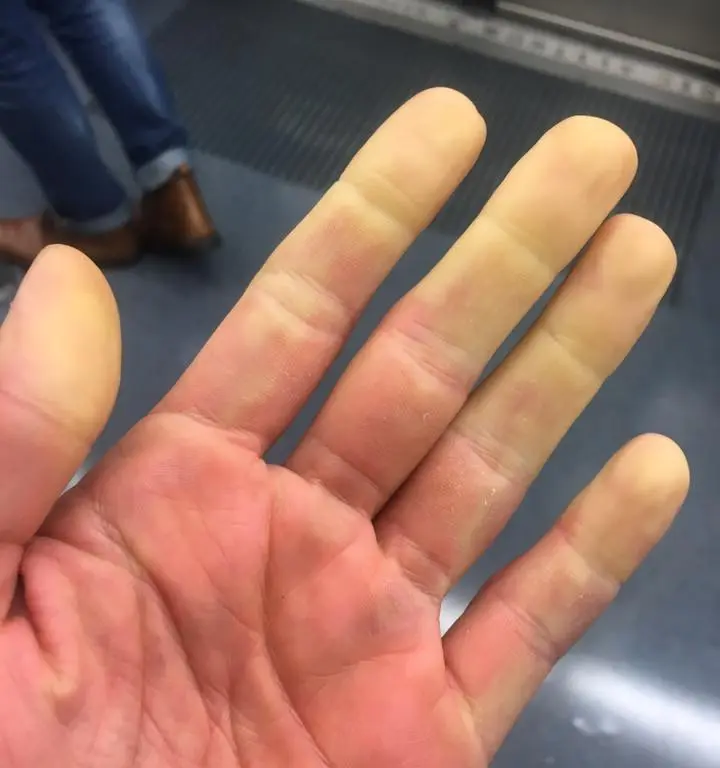
If your hands or feet are changing color when they encounter the cold, it could suggest a major health condition that specialists urge you should not overlook.
When the temperature drops, it’s normal to feel a little chilly. However, you might be experiencing more than just winter misery if your hands and feet become white, blue, or even purple in cold temperatures.
According to Dr. James O’Donovan, who offers medical advise to his more than 400,000 followers on YouTube, the culprit might be Raynaud’s disease, a disorder that can cause some portions of the body to feel numb in response to cold weather or stress.
“In Raynaud’s disease the smaller arteries that supply blood to the skin narrow in response to triggers like cold weather this limits blood flow to the affected areas which is called vasospasm and it then results in symptoms of Raynaud’s,” he added in his YouTube film.
Symptoms
The Mayo Clinic states that the afflicted skin typically becomes pale at first, then changes color before feeling cold and numb.
Among the symptoms are:
cold toes or fingers.
skin patches that first turn white and then blue. Depending on your skin color, these color shifts may be difficult or easier to perceive.
Numb, prickly feeling or stinging pain with warming or lessening of stress.
According to Dr. O’Donovan, “the first thing that you’re likely to notice in terms of signs and symptoms are the areas of your skin that can turn white then blue, depending on your skin color.”
“These colour changes may be harder or easier to see, you may also notice that you’ve got particularly cold fingers or toes or you might notice other changes in the sensation of your hands or feet so things like a numb, prickly feeling or stinging pain.”
He points out that research has not yet been able to determine what’s behind this, but that it usually goes away when the hands and/or feet warm up again.
“Now when the skin warms, and blood flow improves the affected areas may change colour again they may throb tingle or swell…Now even after you’ve warmed up it can take up to 15 minutes for blood flow to return to the area,” he said, adding the numbing or color change can be experienced on other parts of the body, such as the nose, lips, and ears.
Raynaud’s types
Raynaud’s disease comes in two forms – primary and secondary – and while both cause your fingers and toes to change color in the cold, they have some crucial differences.
Primary – Raynaud’s disease: This is the most common and typically mild form. It happens on its own, without being linked to another health condition. Many persons with primary Raynaud’s rarely notice their symptoms and never need treatment. In some situations, it even disappears over time.
Secondary Raynaud’s phenomenon: This kind is less frequent but typically more severe since it is brought on by an underlying medical condition such as a nerve ailment, vascular disease, or autoimmune illness. In contrast to initial Raynaud’s disease, secondary Raynaud’s may need medical intervention to avoid complications.
When to consult a physician
O’Donovan advises seeing a doctor if:
Only one side of the body has symptoms.
You also have muscle weakness, skin rashes, or joint pain.
Toes or fingers remain stained for a long time.
You suffer from excruciating pain, open wounds, or infection symptoms.
You have a history of autoimmune diseases, diabetes, or heart disease.
Your health should always come first, and you should see your doctor if you think something is off. In order for others to know what to watch out for, please share this story!